Plastic Glass Test Tubes | Roundfin

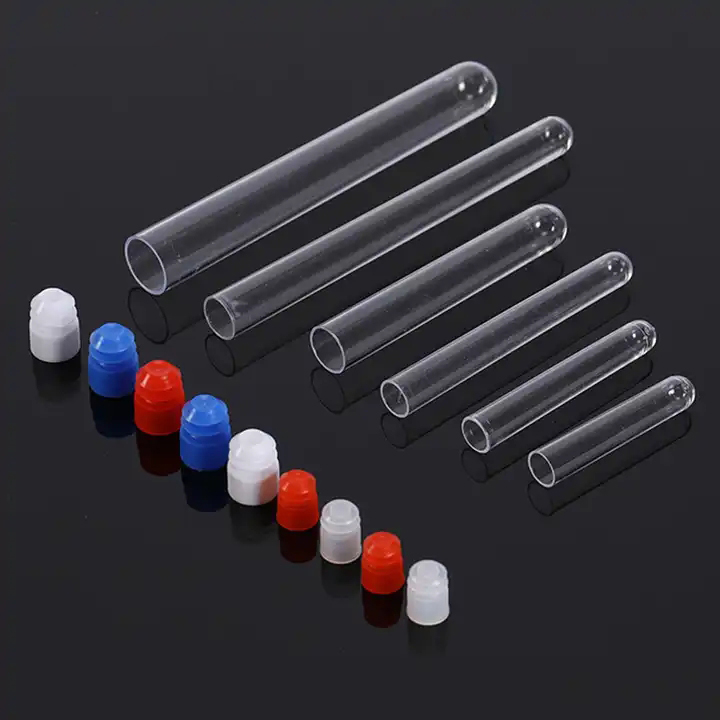
1. Available in polypropylene (PP), polystyrene (PS), and borosilicate glass materials for diverse laboratory requirements from chemical storage to heating applications
2. Diameter range from 12 mm to 40 mm, length from 75 mm to 200 mm — multiple configurations for sample collection, storage, and reaction vessels
3. Borosilicate glass tubes with high thermal shock resistance (up to 500°C) for heating, boiling, and autoclave applications; low expansion coefficient
4. Plastic tubes with leakproof snap caps or screw caps; glass tubes available with PTFE-lined screw caps, rubber stoppers, or cotton plugs
5. Graduated markings at key volume intervals for accurate sample measurement; frosted labeling area for permanent sample identification
6. Sterile and non-sterile options available; CE marked and manufactured under ISO 13485 and ISO 9001 quality standards
Product Overview
Roundfin Plastic & Glass Test Tubes provide versatile sample containment solutions for clinical, research, and industrial laboratory applications. Available in polypropylene (PP) for chemical resistance and autoclaving, polystyrene (PS) for optical clarity, and borosilicate glass for high-temperature applications up to 500°C. Multiple diameter and length configurations accommodate diverse workflows from sample collection and storage to heating, mixing, and centrifugation.
Plastic and Glass Test Tubes for Laboratory Use
Key Takeaway: Roundfin Plastic & Glass Test Tubes — Roundfin quality. CE marked, ISO 13485 certified. Bulk pricing and OEM/ODM customization available for institutional procurement. Worldwide shipping.
Technical Specifications
| Parameter | Specification |
|---|---|
| Diameter Range | 12 mm, 13 mm, 16 mm, 18 mm, 20 mm, 25 mm, 30 mm, 40 mm |
| Glass Thermal Resistance | Up to 500°C (borosilicate); low thermal expansion coefficient 3.3 x 10⁻⁶/K |
| Bottom Type | Round bottom, flat bottom, conical bottom |
| Certifications | CE marked; ISO 13485; ISO 9001; USP Class VI materials |
Key Features
- Three Material Options — PP for autoclaving and chemical resistance; PS for crystal-clear optical quality for visual inspection; borosilicate glass for high-temperature heating, boiling, and long-term chemical storage.
- Wide Size Range — Diameters from 12 mm to 40 mm and lengths from 75 mm to 200 mm provide configurations for micro-volume samples to large-volume reactions and culture tubes.
- Borosilicate Glass 3.3 — Low-expansion borosilicate glass with thermal shock resistance to 500°C for direct flame heating, autoclaving, and rapid temperature cycling without cracking.
- Multiple Closure Options — Snap-cap for quick access, screw-cap with PTFE liner for leakproof chemical storage, silicone stoppers for culture aeration, and cotton plugs for sterile gas exchange in microbiology.
- Graduated Markings — Molded (plastic) or permanent white enamel (glass) graduations at key volume intervals with a frosted labeling area for permanent sample identification with laboratory markers.
- Round, Flat, or Conical Bottom — Round-bottom for heating uniformity, flat-bottom for benchtop stability, and conical-bottom for centrifugation and pellet collection.
Applications
- Routine histology and pathology sample-preparation workflows
- Clinical laboratories processing compatible specimens, blocks or slides
- Research and teaching facilities using microscopy and tissue-processing supplies
- Laboratories confirming size, material and equipment compatibility before ordering
Frequently Asked Questions
Which material should I choose: PP, PS, or borosilicate glass?
Choose PP for chemical resistance, autoclaving, and general-purpose use. Choose PS for optimal optical clarity when visual inspection of samples is critical. Choose borosilicate glass for high-temperature applications (heating, boiling, autoclaving), long-term chemical storage, and applications requiring the lowest possible extractables/leachables profile. Glass is also preferred when sample adsorption to plastic surfaces is a concern.
Are the plastic tubes suitable for centrifugation?
PP tubes can be used for low-speed centrifugation (up to 3,000 x g) when properly supported in the rotor. For high-speed centrifugation, use dedicated centrifuge tubes rated for your specific RCF requirement. PS tubes are not recommended for centrifugation due to lower mechanical strength. Test tube dimensions and rotor compatibility should always be verified before centrifugation.
Can borosilicate glass tubes be heated directly over a flame?
Yes. Borosilicate glass 3.3 tubes can be heated directly over a Bunsen burner or alcohol flame. However, always heat gradually and evenly to avoid thermal shock. Use tube holders or tongs — never hand-hold a tube over a flame. For boiling applications, use boiling chips or glass beads to ensure even boiling and prevent bumping. Do not exceed 500°C.
What is the minimum order quantity for custom sizes or packaging?
Standard sizes and packaging are available in case quantities of 100-1000 tubes depending on configuration. OEM/ODM custom production for non-standard diameters, lengths, or custom packaging is available with minimum order quantities of 10,000-50,000 tubes depending on specifications. Contact Roundfin for a custom production quotation.
Explore related histopathology consumables or contact Roundfin for configuration, compatibility and quotation details.