Rotary Microtome Buying Guide for Pathology and Histology Laboratory Projects
A rotary microtome is one of the core instruments in a pathology or histology laboratory. After tissue processing and paraffin embedding, the microtome determines whether technicians can produce thin, consistent sections for staining and microscopic diagnosis. For hospitals, university laboratories, diagnostic centers and distributors, choosing the right tissue microtome affects slide quality, daily workload, operator comfort and long-term maintenance cost.
This buying guide explains how project buyers can compare rotary microtomes from a practical laboratory workflow point of view. Instead of looking only at model names or price, buyers should review sectioning precision, trimming range, specimen movement, blade holder design, safety features, automation level, installation conditions and supplier support. Roundfin supplies microtome equipment and related pathology instruments for histology laboratories that need reliable sectioning solutions.
Start With the Laboratory's Daily Sectioning Workload
The first question is how the microtome will be used each day. A small hospital laboratory may section a moderate number of paraffin blocks per shift, while a central pathology lab may handle much higher sample volumes and require faster trimming, smoother sectioning and more consistent output across several operators. Workload affects whether a manual, semi-automatic or fully automatic microtome is the most suitable choice.
For low to medium volume labs, a stable manual rotary microtome can be practical if operators are experienced and the sectioning demand is predictable. For higher volume laboratories, semi-automatic or automatic tissue microtomes can reduce repetitive hand motion, improve workflow speed and help maintain sectioning consistency during long shifts. Buyers should also consider whether the lab processes routine biopsy blocks, larger specimens, research samples or teaching materials.
Compare Section Thickness and Trimming Performance
Section thickness control is the main technical point of a rotary microtome. Pathology laboratories usually need thin paraffin sections with repeatable thickness, while trimming settings must remove excess wax quickly before fine sectioning begins. Buyers should compare the section thickness range, trimming thickness range, minimum increment, section accuracy and how clearly the settings are displayed or adjusted.
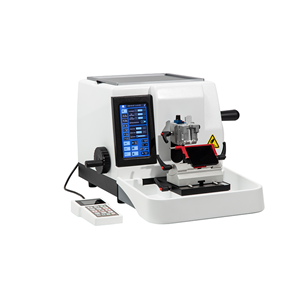
The Roundfin RD-465 Microtome is a useful reference for buyers reviewing standard rotary paraffin microtome specifications. It is designed for precise sectioning of biological and industrial samples, with an ergonomic structure, durable components and a maintenance-focused design. When preparing a tender or quotation request, buyers should ask for complete parameters instead of relying only on general descriptions such as "high precision" or "laboratory grade."
Decide Between Manual, Semi-Automatic and Automatic Operation
Different laboratories have different preferences for control and automation. A manual rotary microtome gives the technician direct handwheel control and can be simple to maintain. A semi-automatic microtome may support motor-assisted specimen feed, remote control functions or digital counting while still allowing manual sectioning. A fully automatic microtome can improve consistency when the lab needs repeatable cutting speed, trimming modes and reduced operator fatigue.
For example, the Roundfin RD-485 PRO Semi-auto Microtome includes automatic tool alignment, remote control operation and section counting functions. These features are relevant when a laboratory wants better workflow control without moving directly to a fully automatic system. For larger laboratories, the Roundfin RD-355ATK Automatic Microtome provides automatic sectioning, trimming, fast forward, fast backward and digital display functions for more demanding daily use.
Review Blade Holder Design and Operator Safety
The blade holder should be treated as a safety and quality component, not a small accessory. A secure blade holder helps maintain stable sectioning, reduces vibration and protects operators from accidental contact with the blade edge. Buyers should confirm whether the microtome supports high-profile blades, low-profile blades or both, and whether the holder is easy to clean and adjust.
Safety features can include a handwheel lock, blade guard, emergency stop, overload protection, clear controls and ergonomic access to trimming and sectioning functions. These details matter because microtome work is repetitive and often performed under time pressure. A safer design can reduce training difficulty and support more consistent operation across different technicians.
Check Specimen Orientation and Clamp Compatibility
Specimen orientation affects how quickly technicians can face the block and achieve an accurate cutting plane. Buyers should compare X-Y orientation range, rotation options, horizontal and vertical specimen movement, maximum specimen size and clamp compatibility. A lab that uses standard embedding cassettes may have different requirements from a research lab working with larger or irregular samples.
Before purchasing, confirm whether the microtome can use the specimen clamps and blade types already common in the laboratory. If the lab is building a new workflow, the microtome should be matched with tissue processing, embedding, flotation bath, slide dryer and staining equipment. This prevents a situation where each instrument is technically acceptable but the whole histology workflow is inefficient.
Evaluate Ergonomics for Long Shifts
Histology technicians may use a microtome for many hours in a shift, so ergonomics should be part of the buying decision. Review the handwheel position, resistance, control layout, trimming switch position, display visibility, waste tray access and how easily the blade holder and specimen clamp can be adjusted. A machine that is difficult to reach or clean may slow the lab even if its technical parameters look strong.
Noise, vibration and bench stability should also be considered. The microtome should sit firmly on the workbench, and the cutting movement should feel smooth. If the lab has limited bench space, confirm the product dimensions and leave enough room for block trays, blade storage, section waste, brushes and nearby flotation bath access.
Plan Maintenance, Calibration and Spare Parts
A microtome is a precision instrument, so maintenance planning is important for long service life. Buyers should ask whether routine cleaning is simple, whether key components are protected from paraffin debris, whether lubrication is required, and how spare parts such as clamps, blade holders, trays and control components can be supplied. For international projects, documentation, packing and after-sales communication are also part of the real purchase value.
Laboratories should keep the microtome clean, avoid wax buildup around the blade holder and specimen clamp, and follow the supplier's recommended maintenance schedule. A stable supplier can help buyers compare models, prepare technical specifications and select compatible accessories before shipment.
Procurement Checklist for Rotary Microtomes
Before confirming an order, review the expected sample volume, section thickness range, trimming range, minimum increment, section accuracy, manual or automatic operation mode, cutting speed, specimen orientation, clamp options, blade holder compatibility, safety lock, emergency stop, display functions, dimensions, voltage, certification, packing size, warranty and spare parts support.
Also check the complete laboratory workflow. A rotary microtome should not be purchased alone if the project also requires tissue processors, embedding centers, cooling plates, flotation baths, slide dryers, cryostats or staining equipment. Matching instruments early helps reduce installation problems and makes daily operation more efficient after the lab opens.
How Roundfin Supports Pathology Laboratory Buyers
Roundfin works with hospitals, pathology laboratories, medical schools, distributors and project contractors that need practical histology and pathology equipment. Buyers can share their sample volume, preferred operation mode, local voltage, budget range and related equipment list, and Roundfin can recommend suitable microtome models for routine sectioning, higher-capacity automatic sectioning or complete pathology lab projects.
If you are planning a new histology laboratory or upgrading existing pathology equipment, contact Roundfin to request microtome specifications, product photos, quotation support and model recommendations. A well-selected rotary microtome should help technicians produce consistent sections, reduce repetitive strain and keep the tissue preparation workflow stable from block trimming to final slide preparation.